
The Burnout Challenge
Employed professionals today face an invisible crisis. You're ambitious, driven, and deeply invested in your work. But you're also exhausted, overwhelmed, and increasingly disconnected from what once gave you meaning.
- Chronic exhaustion that doesn't improve with rest
- Growing cynicism about work that once energized you
- Declining performance despite working harder
- Loss of connection to work's deeper meaning
The gap isn't in awareness. You know something's wrong. The gap is in readiness: you lack the tools to assess your trajectory, predict outcomes, and take effective action before burnout becomes severe.
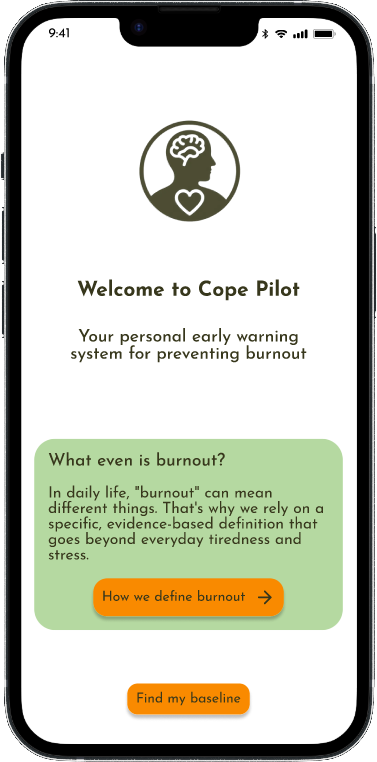
How Cope Pilot Helps
Cope Pilot provides a complete system for burnout prevention through four integrated components:
Assessment
Adaptive questionnaire based on 40+ years of Maslach research measures your burnout across three dimensions: exhaustion, cynicism, and reduced efficacy.
Prediction
Pattern analysis forecasts your trajectory: see where you're headed in 2, 4, and 12 weeks based on current patterns and research-validated models.
Recommendation
Personalized interventions targeted to your specific burnout profile, addressing root causes rather than just symptoms.
Tracking
Daily 2-minute check-ins monitor your progress, detect emerging patterns, and help you understand what's working.
Built on Science, Designed for Trust
Cope Pilot is grounded in Christina Maslach's burnout research, the gold standard in the field for over 40 years, validated across thousands of studies and millions of individuals worldwide.
- Predictive Modeling: Forecasts your trajectory vs static snapshot. Detects drift, not just current state.
- Meaning as Early Warning: Loss of meaning triggers alert before exhaustion. Catches warning signs early.
- Compensated Strain: Identifies when meaning temporarily buffers stress. Reveals hidden cost of resilience.
- Action Decay Model: Models intervention impact realistically with decay curves. Rewards consistency over time.
- Pattern Precision: 9 specific burnout patterns instead of traffic lights. Targets exact fixes needed.
Your privacy is fundamental. All assessment data remains on your device. No data sharing, no surveillance. This is your tool for self-awareness and recovery.
Our approach is informed by clinical expertise in burnout recovery, combining research-validated assessment with practical intervention strategies proven to help.
Meet the Team

Alex Tikhomirov
Co-founder, Product & Engineering
10+ years developer, 3+ years PM. Workshop facilitator on Professional Wellbeing, experienced burnout recovery firsthand.
LinkedIn
Julia Levina
Co-founder, Science & Research
Practicing psychologist-consultant. Does cognitive researches for 2+ years in mental health tech, ensures science-backed approach.
LinkedIn
Marina Matveevskaia
Co-founder, UX & Growth
HR professional, Certified coach, 14+ years in tech. Works with burnout clients, experienced burnout recovery firsthand.
LinkedInFrequently Asked Questions
Burnout is a state of chronic workplace stress characterized by three dimensions: emotional exhaustion (feeling drained and unable to recover), cynicism (detachment from work that once energized you), and reduced efficacy (feeling powerless to make an impact despite your skills). Unlike regular stress that improves with rest, burnout persists and worsens over time. It's not personal weakness. It develops over months when there's a chronic mismatch between you and your job in areas like workload, control, recognition, or values.
Burnout can be prevented if caught early. The critical window is at Stage 1 (early warning signs) before crisis hits. If you catch burnout early and take targeted action, recovery takes 6-12 weeks instead of 6-18 months after crisis. The key is recognizing patterns early (loss of meaning, persistent fatigue, growing cynicism) and intervening before they compound. Prevention isn't about avoiding demanding work. It's about protecting your energy, autonomy, and sense of meaning before exhaustion becomes severe.
Cope Pilot is a four-part system for burnout prevention. First, an adaptive assessment (10-15 minutes) measures your burnout across three dimensions based on 40+ years of Christina Maslach's research. Second, a prediction model forecasts your trajectory at 2, 4, and 12 weeks to show where you're heading if patterns continue. Third, a recommendation engine provides personalized, evidence-based interventions targeted to your specific burnout pattern (not generic "meditate more" advice). Fourth, a tracking framework uses daily 2-minute check-ins to monitor your progress and detect emerging patterns over time.
General wellness apps weren't designed specifically to track burnout symptoms and burnout criteria. While other apps might help with burnout as a side effect of working on particular aspects of mental wellbeing or mindfulness practices, they lack the targeted focus on burnout prevention. Cope Pilot focuses on prediction and prevention through trajectory forecasting, identifies 9 specific burnout patterns (not generic categories), and provides interventions based on YOUR patterns. Our approach is built on Christina Maslach's 40+ years of validated burnout research. We use predictive modeling to detect drift before crisis, identify when loss of meaning serves as an early warning, and model intervention effectiveness realistically. All your health data stays on your device with complete privacy.
Cope Pilot uses predictive modeling to forecast where you're heading, not just where you are now. We calculate your Base Strain Index (a weighted ratio of energy depletion and emotional distance) and apply growth constants to model how your stress patterns will evolve over 2, 4, and 12 weeks if they continue. We also track Meaning Drift as a leading indicator. Loss of purpose often appears before physical exhaustion, giving you earlier warning. This creates urgency ("here's where you're heading") and motivates action before crisis hits, showing you that you're on a trajectory, not just "having a bad week."
Cope Pilot is built on Christina Maslach's burnout research, the gold standard in the field for over 40 years. Maslach is Professor of Psychology (Emerita) at UC Berkeley and creator of the most validated burnout framework globally. Her work forms the basis for WHO's 2019 official classification of burnout. We use Maslach's three core dimensions (exhaustion, cynicism, inefficacy) as the scientific foundation for our assessment and pattern detection. Our algorithms are rooted in this validated framework, enriched with predictive modeling to enable prevention, not just detection.
Cope Pilot was created by three co-founders who understand burnout not just professionally, but personally. Alex Tikhomirov brings over a decade of software development experience and product management background, combined with his work as a workshop facilitator on professional wellbeing. Julia Levina is a practicing psychologist-consultant who has spent years working in mental health tech, bringing the clinical expertise and research rigor that grounds our approach in validated science. Marina Matveevskaia contributes 14 years of tech industry experience as an HR professional and certified coach, working extensively with burnout clients in her coaching practice. Together, they represent a rare combination of technical execution, clinical psychology, and workplace wellness expertise—all informed by their own journeys through burnout and recovery.
Cope Pilot requires 2 minutes per day for check-ins after initial onboarding. The first-time assessment takes 10-15 minutes to establish your baseline and create your personalized recovery plan. Beyond daily check-ins, you'll receive personalized lifestyle recommendations. Since these are highly personal, the time you invest depends on you. But don't be afraid of feeling tired from this work. We nudge you toward things you already enjoy and that boost your energy. This is how we cope with burnout: by doing more of what energizes you, not adding burdensome tasks.
Stay Updated on Our Progress
Follow us on LinkedIn for updates on our closed alpha testing and product development.
Follow on LinkedIn